Nurturing Your Nervous System: Gentle Techniques for Regulation and Inner Peace
Share
Nurturing Your Nervous System: Gentle Techniques for Regulation and Inner Peace
We have all felt it. That sensation of being 'wired and tired', where the body feels exhausted but the mind refuses to switch off. You might find yourself easily startled by a sudden noise or perpetually on edge, feeling as though you are constantly rushing to catch up in a world that demands your undivided attention. Contrast this with the rare, fleeting moments of feeling truly calm, present and centred. For more support, explore our collection of stress management tools.
This difference isn’t just 'all in your head'. It is physiological. It is the work of your nervous system, the body’s master control centre responsible for how we perceive and react to the world. Far too often, we feel like passive victims of our stress responses, tossed about by anxiety or sinking into lethargy. But it does not have to be this way. By understanding the mechanisms of our nervous system, we can learn gentle, body-based techniques to guide ourselves back to a state of balance, resilience and inner peace.
In this article, we will first demystify the body’s alarm system to help you understand why you feel overwhelmed. Then we will explore a practical toolkit of daily practices, from breathwork to grounding, that can help you nurture your nervous system and reclaim your calm. These practices are often central to developing mindfulness.
Understanding Your Body's Alarm System: How to Respond to Overwhelm
To navigate stress effectively, we must first understand the biological processes driving it. Knowledge is empowering, and understanding your physiology can help strip away the shame often associated with anxiety or burnout.
The Basics: Your Autonomic Nervous System (ANS)
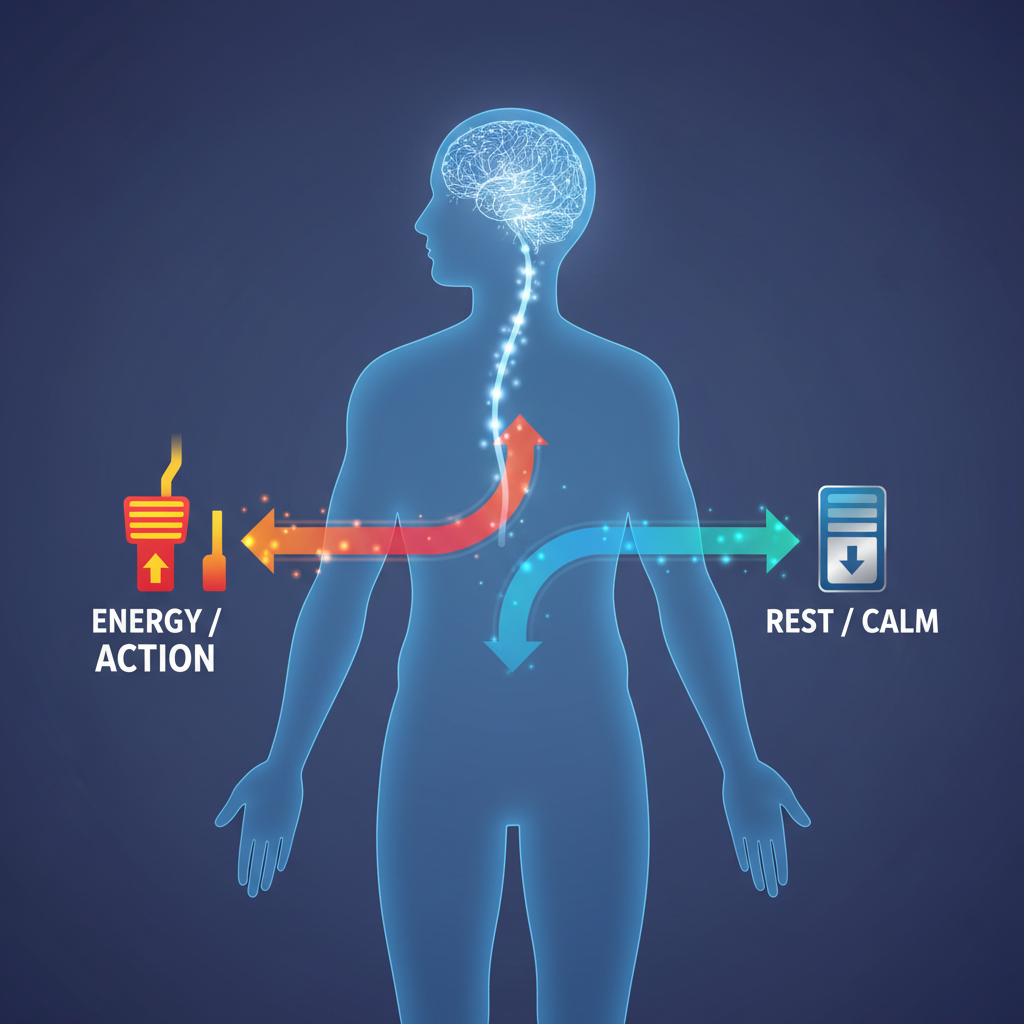
The Autonomic Nervous System (ANS) is the 'automatic' part of your wiring. It operates in the background, regulating essential functions like heart rate, digestion and breathing to keep you alive without you having to think about it. A classic way to understand the ANS is through the analogy of a car.
The **Sympathetic Nervous System** acts as the **gas pedal**. It is your mobilisation system, designed for action and triggering the 'fight-or-flight' response. When activated, it floods the body with adrenaline and cortisol. Your heart rate spikes, blood flows to your muscles and your focus sharpens. This is incredibly helpful if you need to swerve to avoid a car accident or meet a tight deadline. However, it becomes harmful when chronically activated by modern non-life-threatening stressors like overflowing inboxes or traffic jams.
The **Parasympathetic Nervous System** acts as the **brake pedal**. This is your 'rest-and-digest' state. It lowers heart rate, stimulates digestion and promotes immune function and social connection. The activity of this system is largely governed by the Vagus Nerve, the longest cranial nerve in the body. The goal of nervous system regulation is not to eliminate the sympathetic response but to create flexibility between these two states. This balance is known as homeostasis.
A Deeper Look: The Polyvagal Theory
While the gas/brake analogy is useful, modern science offers a more nuanced map called the Polyvagal Theory, introduced by Dr Stephen Porges. This theory highlights the critical role of the Vagus Nerve and introduces a concept called **neuroception**.
Neuroception is your nervous system’s subconscious way of scanning the environment for cues of safety or danger. It happens before you have a conscious thought, which explains why you might suddenly feel anxious or shut down without knowing why. According to this theory, our nervous system moves through three distinct states, often described as a ladder:
1. **Ventral Vagal (Safe & Social):** This is the top of the ladder and the ideal state of regulation. You feel grounded, curious and compassionate. Your heart rate is regulated and you can connect easily with others.
2. **Sympathetic (Fight-or-Flight):** This is the middle of the ladder. When neuroception detects a threat, you drop into this mobilisation state. You might feel anxious, irritated or 'revved up'. Physically, your breathing becomes shallow and your muscles tense.
3. **Dorsal Vagal (Freeze & Shutdown):** This is the bottom of the ladder, the most primitive defence mechanism. If a threat feels inescapable, the body shuts down to conserve energy. You might feel numb, disconnected or stuck. This often manifests as extreme fatigue or a sense of hopelessness.
How to Respond When You Are Dysregulated
When you realise you are overwhelmed, the first step is to **notice and name your state** without judgement. Ask yourself where you are on the ladder. Are you feeling jittery and anxious (Sympathetic)? Or are you feeling heavy and numb (Dorsal Vagal)? Simply acknowledging the state reduces its power.
The antidote to dysregulation is safety. Because dysregulation is a physical response to perceived danger, you cannot simply 'think' your way out of it. You must use 'bottom-up' processing. This means using the body, through breath, movement and sensory input, to send safety signals up to the brain.
Daily Practices for Balance: From Grounding to Mindful Movement
Here is a practical toolkit of techniques to help you regulate. Think of this not as a to-do list but as a menu of options to nurture your nervous system.
The Breath: Your Nervous System's Remote Control
Breathing is one of the few autonomic functions we can consciously control. Slowing the breath directly stimulates the Vagus Nerve, activating the parasympathetic system.
* **Diaphragmatic Breathing:** Lie down and place one hand on your belly. Inhale slowly through your nose, letting your belly expand like a balloon. Exhale slowly, letting the belly fall. This massages the vagus nerve and ensures full lung capacity.
* **The Physiological Sigh:** This is excellent for acute stress. Take a deep inhale through the nose. At the top, take a second, shorter inhale to fully inflate the lungs. Then, release a long, slow exhale through the mouth. Research shows this is one of the fastest ways to lower physiological arousal and signal relaxation.
* **Box Breathing:** Inhale for a count of 4, hold for 4, exhale for 4 and hold the empty breath for 4. This rhythmic pattern is incredibly grounding and helps focus a racing mind.
Grounding: Anchoring Yourself in the Present
Anxiety often pulls us into the future while low mood can keep us stuck in the past. Grounding uses your senses to anchor you in the safety of the present moment.
* **The 5-4-3-2-1 Method:** Look around and name 5 things you see, 4 things you can feel (like the fabric of your chair), 3 things you hear, 2 things you smell and 1 thing you can taste. This forces your brain to process neutral sensory data rather than internal worries.
* **Physical Anchoring:** Press your feet firmly into the floor or push your palms against a wall. Splash cold water on your face. Strong physical sensations provide a clear 'you are here' signal to the brain.
* **Orienting:** Slowly scan the room with your eyes. Turn your head side to side, letting your gaze rest on objects. This mimics the biological behaviour of an animal checking its environment for safety, signalling to your system that there is no immediate threat.
Mindful and Somatic Movement: Releasing Stored Energy
When the stress response is triggered, your body prepares for action. If you don't physically run or fight, that energy gets trapped as tension. Sometimes, having a discrete tool like a fidget necklace can help channel this energy.
* **Gentle Stretching:** Focus on the neck and shoulders where stress often accumulates. Move slowly and sync the movement with your breath to release physical tightness.
* **Shaking:** It might feel silly at first but shaking is a powerful way to discharge stress. Stand up and shake your hands, arms and eventually your whole body for a minute. Animals do this instinctively after a scare to 'shake off' the adrenaline.
* **Rhythmic Movement:** Walking, swimming or simply tapping your hands on your knees in an alternating pattern helps integrate the left and right hemispheres of the brain, promoting a state of flow and calm.
Creating a Regulation Menu
Consistency is more important than intensity. Nurturing your nervous system isn't about spending hours meditating; it is about weaving small moments of safety into your day. You might find that upbeat music helps lift you out of a 'shutdown' state while a weighted blanket calms you down from an 'anxious' state. Experiment with these tools to discover what brings you back to balance.
Conclusion
Your nervous system is constantly communicating with you. The feelings of overwhelm or anxiety you experience are not character flaws but signals from a system trying its best to keep you safe. By learning to listen to these signals and responding with gentle, body-based practices, you can move from a state of constant reaction to one of regulation.
Nurturing your nervous system is a profound act of self-care. It is a journey that allows you to reclaim your sense of safety, connection and inner peace, one gentle breath at a time.


 We have all felt it. That sensation of being 'wired and tired', where the body feels exhausted but the mind refuses to switch off. You might find yourself easily startled by a sudden noise or perpetually on edge, feeling as though you are constantly rushing to catch up in a world that demands your undivided attention. Contrast this with the rare, fleeting moments of feeling truly calm, present and centred. For more support, explore our collection of stress management tools.
This difference isn’t just 'all in your head'. It is physiological. It is the work of your nervous system, the body’s master control centre responsible for how we perceive and react to the world. Far too often, we feel like passive victims of our stress responses, tossed about by anxiety or sinking into lethargy. But it does not have to be this way. By understanding the mechanisms of our nervous system, we can learn gentle, body-based techniques to guide ourselves back to a state of balance, resilience and inner peace.
In this article, we will first demystify the body’s alarm system to help you understand why you feel overwhelmed. Then we will explore a practical toolkit of daily practices, from breathwork to grounding, that can help you nurture your nervous system and reclaim your calm. These practices are often central to developing mindfulness.
We have all felt it. That sensation of being 'wired and tired', where the body feels exhausted but the mind refuses to switch off. You might find yourself easily startled by a sudden noise or perpetually on edge, feeling as though you are constantly rushing to catch up in a world that demands your undivided attention. Contrast this with the rare, fleeting moments of feeling truly calm, present and centred. For more support, explore our collection of stress management tools.
This difference isn’t just 'all in your head'. It is physiological. It is the work of your nervous system, the body’s master control centre responsible for how we perceive and react to the world. Far too often, we feel like passive victims of our stress responses, tossed about by anxiety or sinking into lethargy. But it does not have to be this way. By understanding the mechanisms of our nervous system, we can learn gentle, body-based techniques to guide ourselves back to a state of balance, resilience and inner peace.
In this article, we will first demystify the body’s alarm system to help you understand why you feel overwhelmed. Then we will explore a practical toolkit of daily practices, from breathwork to grounding, that can help you nurture your nervous system and reclaim your calm. These practices are often central to developing mindfulness.
 When you realise you are overwhelmed, the first step is to **notice and name your state** without judgement. Ask yourself where you are on the ladder. Are you feeling jittery and anxious (Sympathetic)? Or are you feeling heavy and numb (Dorsal Vagal)? Simply acknowledging the state reduces its power.
The antidote to dysregulation is safety. Because dysregulation is a physical response to perceived danger, you cannot simply 'think' your way out of it. You must use 'bottom-up' processing. This means using the body, through breath, movement and sensory input, to send safety signals up to the brain.
When you realise you are overwhelmed, the first step is to **notice and name your state** without judgement. Ask yourself where you are on the ladder. Are you feeling jittery and anxious (Sympathetic)? Or are you feeling heavy and numb (Dorsal Vagal)? Simply acknowledging the state reduces its power.
The antidote to dysregulation is safety. Because dysregulation is a physical response to perceived danger, you cannot simply 'think' your way out of it. You must use 'bottom-up' processing. This means using the body, through breath, movement and sensory input, to send safety signals up to the brain.
 Anxiety often pulls us into the future while low mood can keep us stuck in the past. Grounding uses your senses to anchor you in the safety of the present moment.
* **The 5-4-3-2-1 Method:** Look around and name 5 things you see, 4 things you can feel (like the fabric of your chair), 3 things you hear, 2 things you smell and 1 thing you can taste. This forces your brain to process neutral sensory data rather than internal worries.
* **Physical Anchoring:** Press your feet firmly into the floor or push your palms against a wall. Splash cold water on your face. Strong physical sensations provide a clear 'you are here' signal to the brain.
* **Orienting:** Slowly scan the room with your eyes. Turn your head side to side, letting your gaze rest on objects. This mimics the biological behaviour of an animal checking its environment for safety, signalling to your system that there is no immediate threat.
Anxiety often pulls us into the future while low mood can keep us stuck in the past. Grounding uses your senses to anchor you in the safety of the present moment.
* **The 5-4-3-2-1 Method:** Look around and name 5 things you see, 4 things you can feel (like the fabric of your chair), 3 things you hear, 2 things you smell and 1 thing you can taste. This forces your brain to process neutral sensory data rather than internal worries.
* **Physical Anchoring:** Press your feet firmly into the floor or push your palms against a wall. Splash cold water on your face. Strong physical sensations provide a clear 'you are here' signal to the brain.
* **Orienting:** Slowly scan the room with your eyes. Turn your head side to side, letting your gaze rest on objects. This mimics the biological behaviour of an animal checking its environment for safety, signalling to your system that there is no immediate threat.